Case
- ▪ Industry / Branch
- Sustainable & Green IT
- ▪ Role
- Senior Product Designer: End-to-end, from design to development.
- ▪ Services
- Concept · Research · Analysis · UX UI Design & Engineering · Interactive Prototyping · LEAN · Web Development · Usability · Optimization · Accessability Wcag + EAA · Hosting · Project Management
Summary
- ▪ The brief
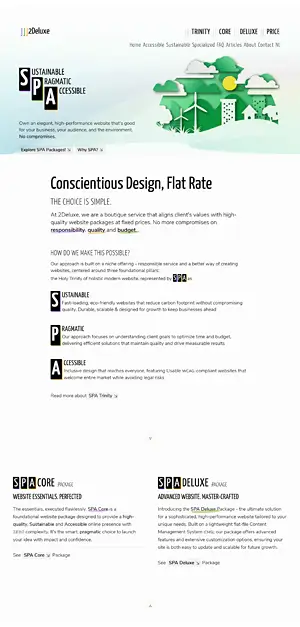
- Create concept and final product for 2Deluxe thats provides Sustainable & Accessible design and development services, emphasizing eco-friendly practices, inclusive design and user-friendly features to promote long-term accessibility and environmental responsibility.
- ▪ Offerings
- From on-line research, existing options were either bloated, power-hungry or mute on the story behind green infrastructure.
Research
- ▪ Initial phase
- Initiated research to bridge the gap between technical sustainability claims and user understanding.
- ▪ Market
- Reviewed competitors in the green hosting space. Most buried their sustainability reports in PDFs or used dense technical jargon that alienated non-technical users.
- ▪ Energy
- Evaluating the energy cost of modern frameworks reinforced the decision: lightweight HTML/CSS/JS ensured the delivery and it is sustainable as the promise.
- ▪ Benchmarking
- Mapped the core user flows against WCAG 2.1 AA standards before a single pixel was placed.
Target
- ▪ Group
- The primary audience consisted of environmentally conscious Small & Medium Enterprises (SME), creative agencies and other.
- ▪ The Green Gap
- Users wanted to make ethical hosting choices but couldn't decipher complex server specs. They needed clear, digestible information about carbon offsetting and renewable energy usage.
- ▪ Fear!
- Many users with accessibility needs were skeptical that a hosting dashboard or service site would actually be navigable with a screen reader or keyboard-only input.
- ▪ Bloat
- The audience valued speed and efficiency - not just for UX and Usability, but because they understood that faster, lighter sites consume less energy.
Persona
- ▪ The Conscious Founder
-
- Age: 30-50
- Role: Founder of a small ethical business, NGO communications lead, or independent creative agency owner.
- Values: Transparency, climate responsibility, inclusivity and long-term thinking.
- Tech Comfort: 'kinda'-understands the basics of hosting but not server-level details.
- Frustration: Wants to make sustainable digital choices but finds most "green" claims vague, unverified, or buried in technical jargon.
- Goal: A hosting and development partner that aligns with their values, clearly communicates environmental impact, and ensures their website is accessible to all users.
- ▪ Meet Sophie
-
- Sophie runs a small design studio focused on circular economy brands. She's late '30, values-driven, and her clients expect her to practice what she preaches.
- She'd just won a climate nonprofit project and needed hosting that ran on renewables and met accessibility standards. Hours of research revealed most providers either buried their sustainability data or offered sluggish, bloated platforms
- What she seeks: Clear, honest information about carbon savings. A site that loads fast and works for everyone. A partner who understands that green shouldn't mean compromised performance.
- What frustrates her: Greenwashing. Heavy, framework-bloated sites marketed as "eco" simply because they bought carbon offsets. Accessibility treated as an afterthought.
Approach
- ▪ Direction
- Insights shaped a storytelling and education-driven concept, featuring high-quality illustrations, full WCAG/EAA Accessibility, craftsmanship pages, and a roadmap for future e-commerce.
- ▪ Education Hub
- A dedicated section explaining European Accessibility Act (EAA) compliance was designed with simplified language, high-contrast visuals, and audio-friendly formatting.
- ▪ Lightweight's
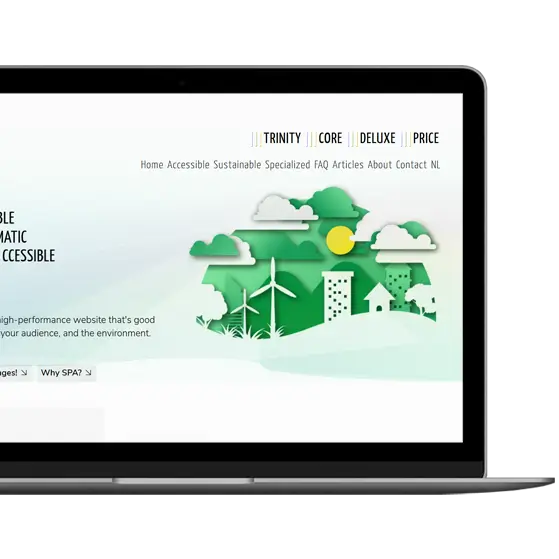
- A minimalist, high-contrast color palette using earthy, organic tones was chosen to visually reinforce the "green" brand. No heavy hero videos or large image applied.
Validation
- ▪ Prototyping
- Built interactive wireframes, hen prototypes directly in code. This allowed for immediate testing of keyboard navigation and screen reader compatibility.
- ▪ Competition
- The competition is limited and lacks credibility. With so few trustworthy benchmarks, validating the approach against established standards proved difficult - which, in turn, offered the freedom to develop a unique solution.
- ▪ Refinement
- Shared with trusted users, the prototype revealed a need for clearer 'Green Stats' labeling. Adjustments were made the same day: a testament to the agility of a lightweight zero-dependency codebase.
Choices
- ▪ Design
- To honor the natural materials and exotic woods, the chosen approach embraced an organic palette, soft pastels, warm woody tones and a minimalist layout that lets the craftsmanship breathe.
- ▪ Development
- The site was built modular with lightweight HTML / CSS and JAVASCRIPT. With the intention as the website expands in the future, components can be reused with ease.
A LEAN approach gave both sides room to pivot quickly, without the weight of major financial setbacks.
Results
- ▪ Environmental Impact
- The site itself operates on a fraction of the energy of a typical WordPress or React site, directly embodying the service it sells.
- ▪ Client Empowerment
- The modular, lightweight code structure allows the client to expand and reuse components easily without vendor lock-in or complex dependency updates.
- ▪ Eye-opener
- Surprisingly, many people are ready to step off the established path of website development and embrace a lightweight, sustainable approach. They also recognize a significant financial upside - everything becomes simpler: to build, to maintain and to expand.
Final
- ▪ Performance
- A perfect 100% Google Lighthouse score across Performance, Accessibility and Best Practices due to the absence of bulky frameworks.
- ▪ Inclusivity
- Full compliance with WCAG 2.1 AA and EAA, including logical focus states, semantic HTML structure, and ARIA labels where appropriate.
- ▪ Visual Identity
- A clean, trustworthy interface that marries technical reliability with a genuine commitment to the planet-showcasing that "green hosting" doesn't mean compromised design.
Case
- ▪ Industry / Branch
- Sustainable & Green IT
- ▪ Role
- Senior Product Designer: End-to-end, from design to development.
- ▪ Services
- Concept · Research · Analysis · UX UI Design & Engineering · Interactive Prototyping · LEAN · Web Development · Usability · Optimization · Accessability Wcag + EAA · Hosting · Project Management
Summary
- ▪ The brief
- Create concept and final product for 2Deluxe thats provides Sustainable & Accessible design and development services, emphasizing eco-friendly practices, inclusive design and user-friendly features to promote long-term accessibility and environmental responsibility.
- ▪ Offerings
- From on-line research, existing options were either bloated, power-hungry or mute on the story behind green infrastructure.
Research
- ▪ Initial phase
- Initiated research to bridge the gap between technical sustainability claims and user understanding.
- ▪ Market
- Reviewed competitors in the green hosting space. Most buried their sustainability reports in PDFs or used dense technical jargon that alienated non-technical users.
- ▪ Energy
- Evaluating the energy cost of modern frameworks reinforced the decision: lightweight HTML/CSS/JS ensured the delivery and it is sustainable as the promise.
- ▪ Benchmarking
- Mapped the core user flows against WCAG 2.1 AA standards before a single pixel was placed.
Target
- ▪ Group
- The primary audience consisted of environmentally conscious Small & Medium Enterprises (SME), creative agencies and other.
- ▪ The Green Gap
- Users wanted to make ethical hosting choices but couldn't decipher complex server specs. They needed clear, digestible information about carbon offsetting and renewable energy usage.
- ▪ Fear!
- Many users with accessibility needs were skeptical that a hosting dashboard or service site would actually be navigable with a screen reader or keyboard-only input.
- ▪ Bloat
- The audience valued speed and efficiency - not just for UX and Usability, but because they understood that faster, lighter sites consume less energy.
Persona
- ▪ The Conscious Founder
-
- Age: 30-50
- Role: Founder of a small ethical business, NGO communications lead, or independent creative agency owner.
- Values: Transparency, climate responsibility, inclusivity and long-term thinking.
- Tech Comfort: 'kinda'-understands the basics of hosting but not server-level details.
- Frustration: Wants to make sustainable digital choices but finds most "green" claims vague, unverified, or buried in technical jargon.
- Goal: A hosting and development partner that aligns with their values, clearly communicates environmental impact, and ensures their website is accessible to all users.
- ▪ Meet Sophie
-
- Sophie runs a small design studio focused on circular economy brands. She's late '30, values-driven, and her clients expect her to practice what she preaches.
- She'd just won a climate nonprofit project and needed hosting that ran on renewables and met accessibility standards. Hours of research revealed most providers either buried their sustainability data or offered sluggish, bloated platforms
- What she seeks: Clear, honest information about carbon savings. A site that loads fast and works for everyone. A partner who understands that green shouldn't mean compromised performance.
- What frustrates her: Greenwashing. Heavy, framework-bloated sites marketed as "eco" simply because they bought carbon offsets. Accessibility treated as an afterthought.
Approach
- ▪ Direction
- Insights shaped a storytelling and education-driven concept, featuring high-quality illustrations, full WCAG/EAA Accessibility, craftsmanship pages, and a roadmap for future e-commerce.
- ▪ Education Hub
- A dedicated section explaining European Accessibility Act (EAA) compliance was designed with simplified language, high-contrast visuals, and audio-friendly formatting.
- ▪ Lightweight's
- A minimalist, high-contrast color palette using earthy, organic tones was chosen to visually reinforce the "green" brand. No heavy hero videos or large image applied.
Validation
- ▪ Prototyping
- Built interactive wireframes, hen prototypes directly in code. This allowed for immediate testing of keyboard navigation and screen reader compatibility.
- ▪ Competition
- The competition is limited and lacks credibility. With so few trustworthy benchmarks, validating the approach against established standards proved difficult - which, in turn, offered the freedom to develop a unique solution.
- ▪ Refinement
- Shared with trusted users, the prototype revealed a need for clearer 'Green Stats' labeling. Adjustments were made the same day: a testament to the agility of a lightweight zero-dependency codebase.
Choices
- ▪ Design
- To honor the natural materials and exotic woods, the chosen approach embraced an organic palette, soft pastels, warm woody tones and a minimalist layout that lets the craftsmanship breathe.
- ▪ Development
- The site was built modular with lightweight HTML / CSS and JAVASCRIPT. With the intention as the website expands in the future, components can be reused with ease.
A LEAN approach gave both sides room to pivot quickly, without the weight of major financial setbacks.
Results
- ▪ Environmental Impact
- The site itself operates on a fraction of the energy of a typical WordPress or React site, directly embodying the service it sells.
- ▪ Client Empowerment
- The modular, lightweight code structure allows the client to expand and reuse components easily without vendor lock-in or complex dependency updates.
- ▪ Key Learning
- Surprisingly, many people are ready to step off the established path of website development and embrace a lightweight, sustainable approach. They also recognize a significant financial upside - everything becomes simpler: to build, to maintain and to expand.
Final
- ▪ Performance
- A perfect 100% Google Lighthouse score across Performance, Accessibility and Best Practices due to the absence of bulky frameworks.
- ▪ Inclusivity
- Full compliance with WCAG 2.1 AA and EAA, including logical focus states, semantic HTML structure, and ARIA labels where appropriate.
- ▪ Visual Identity
- A clean, trustworthy interface that marries technical reliability with a genuine commitment to the planet-showcasing that "green hosting" doesn't mean compromised design.